
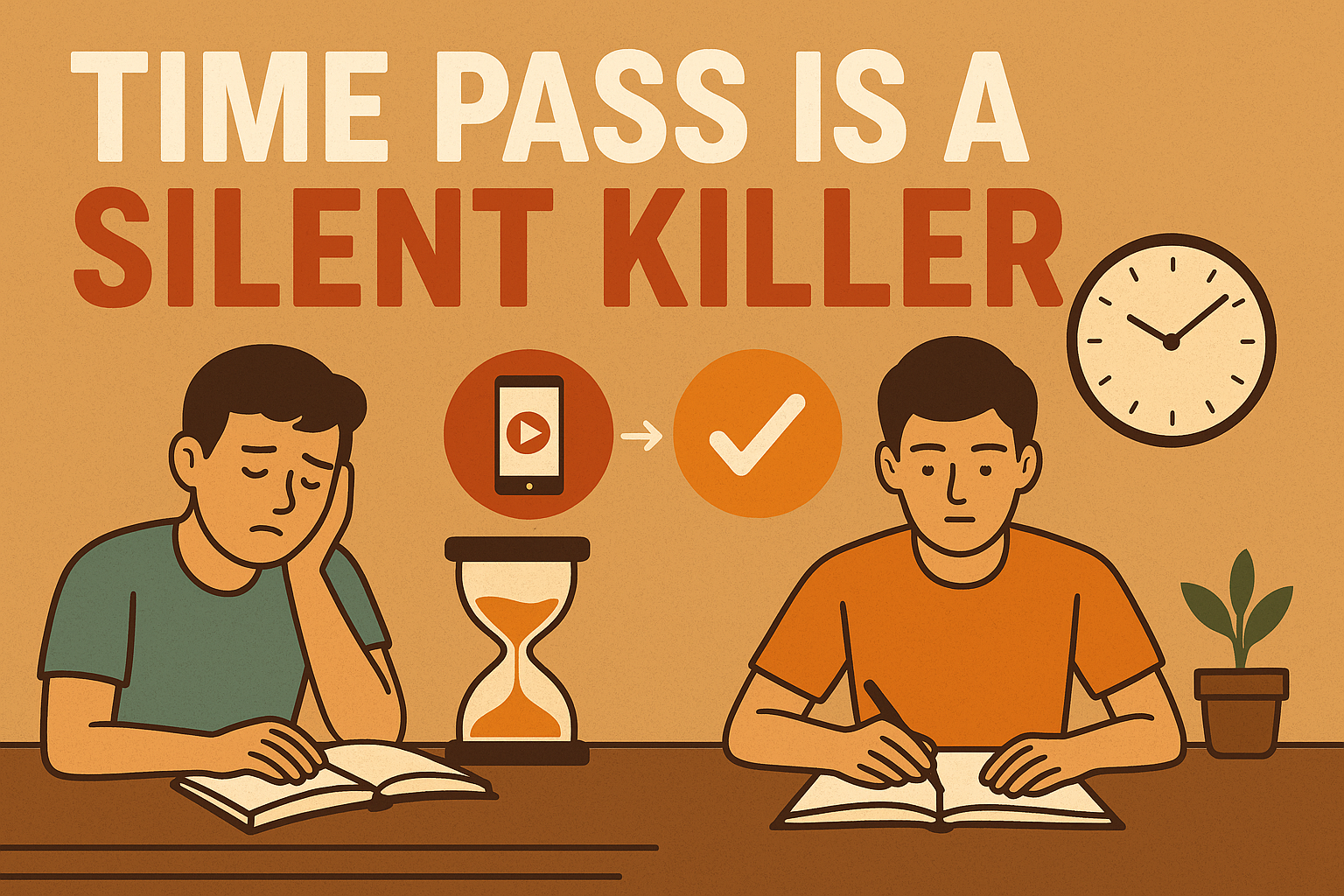
“Time Pass is a Silent Killer”
This short but powerful line carries a great life lesson, especially for students and young achievers.
1. Meaning of the Phrase
“Time pass” means spending time without any meaningful purpose — just to entertain oneself or avoid boredom.
Examples include:
At first, it feels harmless — just “passing time.”
But slowly and silently, it kills your time, focus, and potential.
2. Why It’s Called a “Silent Killer”
Like a disease that spreads without symptoms, “time pass” destroys your future quietly.
You don’t realize its damage immediately — but over time, it:
Example:
A student who wastes just 2 hours daily on unproductive “time pass” loses about 60 hours a month, i.e. 720 hours a year — that’s an entire month of lost growth!
3. The Psychology Behind It
Our brain naturally chooses comfort over challenge.
So when you’re tired or bored, your brain says:
“Let’s just chill a bit…”
But that “bit” turns into hours.
Gradually, your brain becomes addicted to distraction, and you start feeling lazy even about small tasks.
Research from Stanford University shows that frequent distraction reduces the brain’s ability to concentrate and perform deep work — meaning your mental sharpness and memory power decrease over time.
4. The Consequences of ‘Time Pass’
Missed syllabus, poor preparation, weak concepts
Lack of clarity, poor decision-making
Guilt and frustration due to wasted time
Lost opportunities, delayed progress
Broken habits and inconsistency
So, “time pass” doesn’t just waste hours — it silently kills your dreams.
5. How to Stop Time Pass and Use Time Wisely
(a) Set Clear Goals
When you know what to achieve, you automatically stop wasting time.
Write your daily targets and track your progress.
(b) Plan Study and Rest Properly
Keep fixed timings for study, break, and entertainment — don’t mix them.
(c) Use the 2-Minute Rule
If you are tempted to waste time, tell yourself:
“Just study or do something productive for 2 minutes.”
Often, that short start leads to long focus.
(d) Stay in a Motivating Environment
A library, classroom, or study group reduces distractions.
Environment shapes discipline.
(e) Remind Yourself of the Cost of Wasted Time
Think: “Every hour wasted today is one opportunity lost tomorrow.”